Endoscopic Carpal Tunnel Release
Reviewed by Dr. Vipul Patel
Endoscopic Carpal Tunnel Release in Manhattan, Brooklyn, Queens and Englewood, NJ
Numbness, tingling and weakness in your thumb, index and middle fingers, especially at night, are classic signs of carpal tunnel syndrome. When splints, activity changes and injections no longer bring relief, carpal tunnel release surgery may help.
Endoscopic carpal tunnel release is one surgical approach to relieving pressure on the median nerve through a smaller incision. We evaluate patients for carpal tunnel surgery at our offices on the Upper West Side of Manhattan, in Park Slope, Brooklyn, in Elmhurst, Queens, and in Englewood, NJ, and help you decide which approach fits your hand.
What Is Endoscopic Carpal Tunnel Release?
Carpal tunnel syndrome occurs when the median nerve is compressed inside a narrow passage at the wrist. All carpal tunnel release procedures divide the transverse carpal ligament, the roof of the tunnel, to create more space for the nerve.
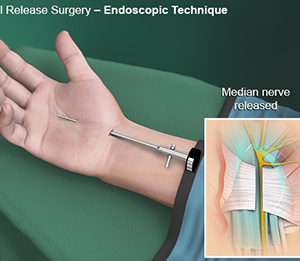
In the endoscopic technique, the surgeon uses one or two small incisions at the wrist or palm and a thin camera called an endoscope to view and release the ligament from underneath. Traditional open release uses a single longer incision in the palm.
What Are the Benefits of Endoscopic Carpal Tunnel Release?
For appropriately selected patients, potential benefits may include:
- Smaller incisions: less disruption of the skin of the palm
- Less early tenderness: some patients report less palm soreness in the first weeks
- Earlier return to some activities: particularly light hand use
- Outpatient procedure: you usually go home the same day
Benefits vary depending on the patient, and long-term results of endoscopic and open release are generally similar.
When Is Endoscopic Carpal Tunnel Release Recommended?
Surgery may be considered when:
- Symptoms persist despite splinting, activity changes or injections
- Numbness is constant rather than intermittent
- Nerve testing shows moderate or severe compression
- You notice thumb weakness or muscle wasting
Not every patient is a candidate for the endoscopic approach. Dr. Patel can evaluate your hand and nerve testing to recommend open or endoscopic release.
How Is Endoscopic Carpal Tunnel Release Performed?
The procedure is typically performed with local or regional anesthesia, sometimes with sedation. A small incision is made near the wrist crease, and sometimes a second in the palm. The endoscope is passed beneath the ligament so the surgeon can see it on a monitor, confirm that the nerve and tendons are protected, and divide the ligament. The incisions are closed and a soft dressing is applied.
What to Expect During Recovery
You are usually encouraged to move your fingers soon after surgery and to keep your hand elevated. Light tasks may resume within days, while heavier gripping returns gradually over several weeks. Night symptoms often improve early, but numbness from long-standing compression may take longer to recover, and in severe cases may not fully resolve. See our carpal tunnel surgery recovery timeline for more detail.
What Are the Risks of Endoscopic Carpal Tunnel Release?
Possible risks include:
- Infection
- Bleeding or bruising
- Tenderness at the base of the palm (pillar pain)
- Incomplete release of the ligament
- Injury to the median nerve or its branches, which is uncommon
- Stiffness
- Persistent or recurrent symptoms
- Need to convert to an open procedure during surgery
Your surgeon can discuss these risks based on your individual condition.
Why Choose Dr. Patel for Carpal Tunnel Surgery in New York?
Dr. Vipul Patel, MD, FAAOS, is a board-certified orthopedic surgeon whose practice focuses on nerve compression syndromes, including carpal tunnel syndrome. He completed fellowship training in hand and upper extremity surgery at Harvard/Massachusetts General Hospital and teaches orthopedic residents at NYU Langone Orthopedic Hospital and NewYork-Presbyterian Brooklyn Methodist Hospital.
Endoscopic Carpal Tunnel Release FAQs
Is endoscopic release better than open release?
Both approaches release the same ligament and have similar long-term results. Endoscopic release may offer a faster early return for some patients. Your surgeon can explain which approach suits your anatomy and symptoms.
Can both hands be treated at the same time?
Some patients have both hands treated together, while others prefer to stage them so one hand remains free for daily tasks. Your surgeon can help you weigh the practical trade-offs.
Will I need nerve testing before surgery?
A nerve study is often recommended to confirm the diagnosis and measure severity before surgery. Your surgeon will let you know whether testing is needed in your case.
Request an Appointment for Carpal Tunnel Release
If numbness and tingling are disrupting your sleep or work, request an appointment at our Manhattan, Brooklyn, Queens or Englewood, NJ office to discuss your carpal tunnel treatment options.