Ultrasound-Guided Carpal Tunnel Release
Reviewed by Dr. Vipul Patel
Ultrasound-Guided Carpal Tunnel Release in Manhattan, Brooklyn, Queens and Englewood, NJ
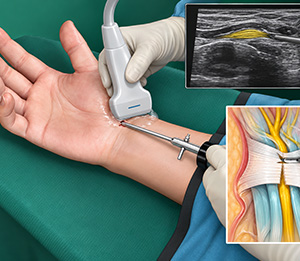
If carpal tunnel syndrome is keeping you up at night or making your fingers numb at work, you may have read about ultrasound-guided carpal tunnel release, a newer approach that uses a very small incision. Understanding how it compares with other techniques can help you have a more informed conversation about surgery.
We evaluate carpal tunnel syndrome at our offices on the Upper West Side of Manhattan, in Park Slope, Brooklyn, in Elmhurst, Queens, and in Englewood, NJ, and can explain which surgical approaches may suit your condition.
What Is Ultrasound-Guided Carpal Tunnel Release?
Like other forms of carpal tunnel release, this procedure divides the transverse carpal ligament to relieve pressure on the median nerve. The difference is in how the surgeon sees the ligament. Instead of a palm incision or a camera, ultrasound imaging is used in real time to guide a small cutting device through an incision that is typically only a few millimeters long.
Because the technique is newer than open and endoscopic release, long-term research is still growing. It requires specialized training and equipment, and it may not be suitable for every hand.
What Are the Potential Benefits?
For appropriately selected patients, potential benefits may include:
- Very small incision: often closed without stitches or with minimal closure
- Local anesthesia: the procedure may be performed in a procedure room setting
- Earlier return to light activity: some patients resume daily tasks quickly
- Less palm soreness: because the palm skin is not opened
Benefits vary depending on the patient and the surgeon's experience with the technique.
When Might This Approach Be Considered?
- Carpal tunnel symptoms persist despite splinting or injections
- Nerve testing confirms median nerve compression at the wrist
- Ultrasound shows anatomy that can be clearly visualized
- No other condition, such as a mass or prior surgery, requires an open approach
Not every patient with carpal tunnel syndrome is a candidate. Dr. Patel can evaluate your hand and explain which release options may be appropriate.
How Is the Procedure Performed?
After the wrist is numbed with local anesthesia, the surgeon maps the median nerve, arteries and ligament with ultrasound. A tiny incision is made at the wrist, and a small device is guided under ultrasound so the ligament can be divided while nearby structures are kept in view. A small bandage is applied afterward.
What to Expect During Recovery
Many patients are encouraged to use the hand for light tasks soon after the procedure. Heavier gripping returns over the following weeks. As with any carpal tunnel release, nerve recovery depends on how severe and long-standing the compression was.
What Are the Risks?
- Incomplete release of the ligament
- Injury to nerves, blood vessels or tendons
- Infection
- Bleeding or bruising
- Palm tenderness
- Persistent or recurrent symptoms
- Need for a different or additional procedure
Your surgeon can discuss these risks based on your individual condition.
Why Choose Dr. Patel for Carpal Tunnel Care?
Dr. Vipul Patel, MD, FAAOS, is a board-certified orthopedic surgeon with fellowship training in hand and upper extremity surgery from Harvard/Massachusetts General Hospital. He treats nerve compression syndromes, including carpal tunnel syndrome, and discusses each surgical approach openly so you can make a shared decision.
Ultrasound-Guided Carpal Tunnel Release FAQs
How is this different from endoscopic carpal tunnel release?
Both release the same ligament through small incisions. Endoscopic release uses a camera placed under the ligament, while the ultrasound-guided approach uses imaging from outside the skin to guide the device.
Is ultrasound-guided release right for me?
It depends on your anatomy, the severity of your nerve compression and your surgeon's assessment. An evaluation can help determine whether this or another approach makes sense.
Does insurance cover ultrasound-guided carpal tunnel release?
Coverage varies by plan and procedure code. We recommend checking with your insurance carrier, and our office can help you understand what information to request.
Request an Appointment
If you are exploring carpal tunnel surgery, request an appointment at our Manhattan, Brooklyn, Queens or Englewood, NJ office to discuss your carpal tunnel release options.