Scapholunate Ligament Tear
Reviewed by Dr. Vipul Patel
Scapholunate Ligament Tear Treatment in Manhattan, Brooklyn, Queens and Englewood, NJ
A fall on an outstretched hand can injure more than bone. The scapholunate ligament, which connects two key wrist bones, is one of the most commonly injured wrist ligaments, and the injury can be missed when X-rays first look normal. Early evaluation matters, because a long-standing tear can change how the wrist moves and loads over time.
We diagnose and treat scapholunate injuries at our offices on the Upper West Side of Manhattan, in Park Slope, Brooklyn, in Elmhurst, Queens, and in Englewood, NJ.
What Is a Scapholunate Ligament Tear?
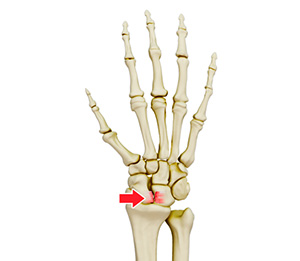
The scapholunate ligament holds the scaphoid and lunate bones together in the first row of the wrist. When it tears, the two bones can drift apart and rotate abnormally. Over years, this altered motion may lead to a pattern of wrist arthritis known as scapholunate advanced collapse (SLAC).
Types of Scapholunate Injuries
- Partial tears: some ligament fibers remain intact and the bones stay aligned at rest
- Complete tears: the ligament no longer holds the bones together, and a gap may appear on stress X-rays
- Chronic tears: older injuries that may have led to cartilage wear
Symptoms
- Pain and swelling on the back of the wrist, on the thumb side
- Weak grip
- Clicking or clunking with wrist motion
- Pain when pushing up or bearing weight on the hand
How a Scapholunate Tear Is Diagnosed
Your surgeon will examine the wrist and may perform specific stress tests. Standard and clenched-fist X-rays can show widening between the bones. An MRI may help, and wrist arthroscopy can grade the tear directly when the diagnosis is uncertain.
Nonsurgical Options to Try First
Partial tears without instability may improve with splinting, activity changes and hand therapy focused on muscles that help stabilize the wrist.
When Surgery May Be Recommended
Surgery may be considered for complete tears, dynamic or static instability, or ongoing pain despite nonsurgical care. Acute injuries may have more repair options than chronic ones, which is one reason not to wait if your wrist pain persists after a fall.
Surgical Options That May Be Considered
- Arthroscopic debridement and pinning: for selected partial tears
- Ligament repair: for recent complete tears with healthy tissue
- Ligament reconstruction: using tendon graft for tears that cannot be repaired; see our wrist ligament reconstruction page
- Salvage procedures: such as partial wrist fusion or proximal row carpectomy when arthritis has developed
Recovery
Repair and reconstruction usually require a period of casting or splinting, sometimes with temporary pins, followed by structured hand therapy. Return to heavy use is gradual and may take several months.
Why Choose Dr. Patel for Wrist Ligament Care?
Dr. Vipul Patel, MD, FAAOS, completed fellowship training in hand and upper extremity surgery at Harvard/Massachusetts General Hospital and has additional background in orthopedic biomechanics from NYU's Musculoskeletal Research Center, which informs his approach to complex wrist injuries.
Scapholunate Ligament Tear FAQs
Why did my X-ray look normal if the ligament is torn?
Ligaments do not show on X-rays, and the bones may stay aligned at rest. Stress views, an MRI or arthroscopy may be needed to reveal the injury.
What happens if a scapholunate tear is not treated?
Some tears remain mildly symptomatic, but complete tears can lead to abnormal wrist motion and, over years, arthritis. An evaluation can help you understand your individual risk.
Is surgery always needed for a complete tear?
Not always. Treatment depends on your symptoms, the age of the injury and your activity level. Your surgeon can walk you through the options.
Request an Appointment
If your wrist still hurts after a fall, request an appointment at our Manhattan, Brooklyn, Queens or Englewood, NJ office to discuss your scapholunate ligament treatment options.